
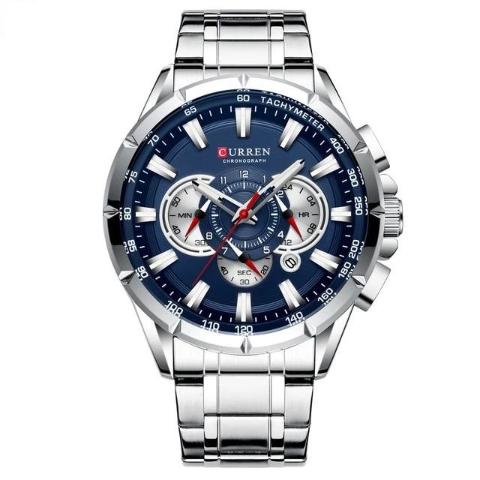
A chronograph is a watch with a stopwatch that works alongside the regular time display. On many analog chronographs, a small hand keeps ticking with the time while the long center stopwatch hand rests at 12. If the long hand is still, check which hand the manual identifies as the running seconds before assuming the battery has died.
Work out what each hand measures
- Running seconds show the seconds of the current time and keep moving with the watch.
- Elapsed seconds start when you activate the stopwatch. They may use the long center hand or a subdial.
- Elapsed minutes count completed minutes on a separate scale. Some watches also have a counter for elapsed hours.
- A 24-hour subdial can show the current time on a 24-hour scale. Check whether it follows the main time or measures elapsed time before including it in your reading.
Try a dry test at your desk
Consult your model’s instructions for the button layout. On a common two-pusher design, one button starts and stops the stopwatch and the other resets it after it stops. Start a timer on your phone at the same time, wait until just over one minute has passed, then stop the watch. This shows which hand tracks seconds and which register advances past the first minute. If the minute counter reads 2 and the stopwatch seconds hand reads 17, your elapsed time is 2 minutes and 17 seconds. Reset only as directed by the manual. Seiko’s illustrated chronograph instructions show one example of a start, stop, and reset layout.
Check the product description before you buy
Look for a stated chronograph function and check which hands record elapsed time. A photograph can show the number of subdials, while the manual or a model-specific demonstration tells you what they do. If you routinely time 45-minute intervals, ask how many minutes the counter can display before it wraps around.
ThornTerra lists the Cadence CUR181 as a quartz chronograph with a stainless steel band. The Meridian 8329 also lists a quartz movement and chronograph function, with a leather strap and a 14 mm case thickness. Compare which dial markings are easier for you to read. If you need a particular timing range or subdial layout, check the model instructions before ordering.